How to read a script without sounding scripted
Write the script the way you talk, then perform it instead of reading it. Use short sentences and contractions, put a line break wherever you breathe, and say it out loud twice before recording so you know where every sentence is going. On the take, slow down, pause at the ends of ideas, and change your pace rather than your volume. Most read-sounding videos fail on rhythm, not on the words, so fix the rhythm first.
Updated
Write for the ear, not the page
- Use contractions. “It’s” and “you’ll” are how people talk; “it is” and “you will” are how people write.
- One idea per sentence. If a sentence needs a comma to hold together, it probably wants to be two.
- Drop words you never say out loud: “furthermore”, “aforementioned”, “in order to”.
- Write numbers, prices and dates the way you will say them, so you never translate mid-sentence.
- Read the draft aloud once and rewrite every line you stumble on. Stumbles on the page become stumbles on camera.
Mark the performance in the script
Line breaks are breaths. Put one wherever you want to take a breath or land a point, and a blank line between ideas. The script template shows the format.
Put directions in square brackets — [pause], [smile], [slower] — so they remind you without being read. In OwlPrompter they show faintly on the prompter and stay out of captions, and with Pro, voice scroll glides over them.
Put the word you want to stress at the end of a line. The natural pause after a line break does the emphasis for you.
Rehearse the meaning, not the words
-
Summarise each paragraph in a few words
If you can say what a paragraph is for in five words, you will read it like you mean it instead of like you are decoding it.
-
Say it once without the script
Talk through the whole thing in your own words, badly. It does not matter; it tells your voice where the sentences are going.
-
Then read it
Now the script is a reminder of something you already know how to say, not a text you are seeing for the first time.
On the take
- Slow down. Tauroza and Allison’s measurements put average speech at 125–160 words per minute; nerves push most people above that. The speech timer cites the research.
- Vary pace, not volume. Speed up through lists, slow down for the point you want remembered.
- Pause at the end of ideas, not just at commas. A two-beat pause sounds confident on camera, even when it feels long.
- Let the scroll follow you. A fixed speed makes you keep up with it; with Pro, OwlPrompter’s voice scroll waits when you pause.
- Smile before the first line. It changes how the first sentence sounds.
Review the take
Listen to it with your eyes closed. Flat, evenly spaced sentences are the sound of reading; you will hear them immediately.
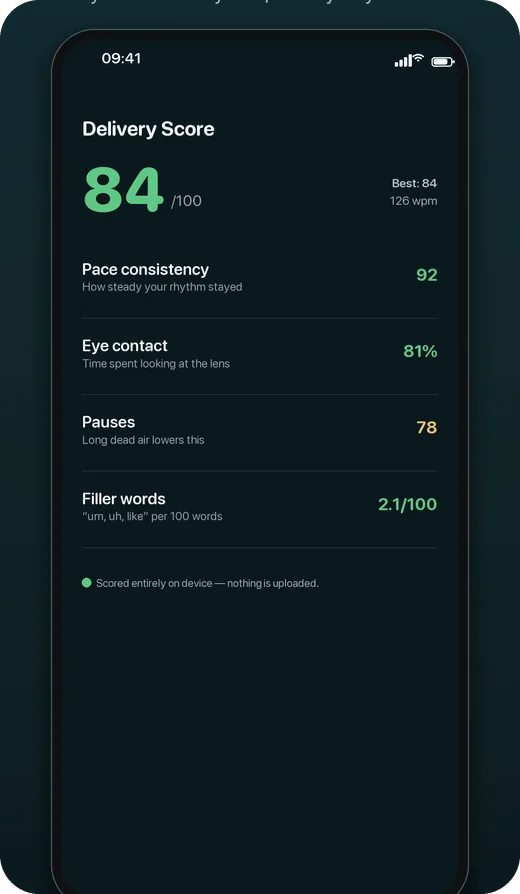
The Delivery Score in OwlPrompter puts numbers on the same things: pace consistency, pauses, filler words per 100 spoken and eye contact. Pro adds one-tap removal of “um”, “so” and dead air.
Questions
What speaking pace sounds natural?
In Tauroza and Allison’s study of British English, 125 to 160 words per minute counts as average, 100 to 125 as moderately slow and 160 to 185 as moderately fast. Scripted video usually sounds best inside the average band.
Should I memorise my script instead of reading it?
Memorise the first and last lines, which carry the most weight, and read the middle. Fully memorised scripts often sound more recited than read ones.
How do I stop saying “um”?
Replace it with a silent pause; the pause sounds deliberate and the filler does not. A Delivery Score after each take counts filler words so you can see whether it is working.